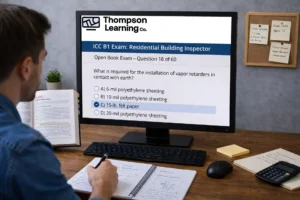
TLC Pro -Tips: How to Pass the 2024 B1 Exam
By Metta Holliday, Codebook Expert
To pass the ICC 2024 B1 Residential Building Inspector exam, you have to think like an inspector. Your focus shouldn’t be on memorization; it needs to be on navigation and interpretation. Since the exam is based strictly on Chapters 1–11 of the 2024 International Residential Code (IRC), your success depends entirely on your ability to navigate these chapters under pressure.
Having helped thousands of students pass inspector code exams over the last 20 years, I can tell you the ultimate secret. “You pass the exam by mastering how to find answers quickly during that tight 2-hour window.“
Here are the three areas you must master:
1) Structural Provisions (Floors, Walls, and Roofs)
This is the “meat” of the exam. You’ll be heavily tested on how a house stays standing.
-
Joists and Rafters: Know how to use the span tables (Chapters 5-6 and 8-9) to determine maximum allowable spans based on wood species, grade, and spacing.
-
Braced Wall Lines: This is often the trickiest part of the B1. You must understand the different methods of bracing (Chapter 6) for residential structures.
-
Fastening Schedules: Be ready to look up the required nailing patterns for headers, studs, and sheathing quickly.
2) Means of Egress and Life Safety
The ICC prioritizes life safety above all else. If a question involves someone escaping a fire, assume it’s a critical path question.
-
Emergency Escape and Rescue Openings (EERO): Know the exact dimensions for egress windows, including minimum net clear opening, minimum height, and minimum width.
-
Stairways and Handrails: Be able to index maximum riser height, minimum tread depth, landing requirements, and what constitutes a “graspable” handrail.
-
Smoke and Carbon Monoxide Alarms: Know exactly where they are required to be placed inside and outside of sleeping areas.
3) Footings and Foundations
This section tests your ability to interpret the foundation system from the ground up.
-
Depth and Frost Line: Understand footing depth requirements—specifically that they must extend below the local frost line or be protected from frost.
-
Reinforcement: Know the requirements for rebar placement and concrete strength (PSI) based on the local weathering potential.
-
Anchor Bolts: Pay close attention to the spacing and placement of anchor bolts securing the sill plate to the foundation (Chapter 4).
Stop Searching, Start Passing
The B1 is an open-book exam, but time is your biggest enemy. If you are reading the code for the first time during the test, you will run out of time.
That is exactly why we created the Keyword Indexing Method. Instead of flipping pages blindly, our method trains you to identify the core keyword in the question and find the exact code section in under two minutes.



 Take the Free 2024 B1 Practice Challenge